


Dallas Federal Criminal Defense Attorney
Federal crimes are vastly different from state crimes. A federal crime refers to a violation of a statute that is passed by the U.S. Congress—generally a regulation or law of national concern, such as crimes that occur across state lines. Federal crimes are typically factually and legally complex, and are known for tight deadlines and harsher penalties. While probation might be the standard for almost all crimes in state court, it is highly likely for there to be a probation plea offer or straight up sentence in federal court.
Conviction rates for federal crimes are typically high as the prosecution is generally backed by an extensive investigation conducted by multiple specialized government agencies. Unfortunately, an arrest will put your rights, your family, your career, and your freedom at risk. Only an experienced federal criminal defense attorney with a deep understanding of federal law can provide the quality representation needed for a federal criminal charge.
If you face federal criminal charges, seeking representation from a federal criminal defense lawyer should be a top priority. That is what David Finn, P.C. can provide. Call (214) 538-6629 today to schedule an initial consultation.
Federal vs. State Crimes
Federal cases can be extremely complex in nature, and are very different from state crimes.
While state crimes are comprised of numerous offenses that occur frequently, federal crimes generally fall under fewer classifications or classes as they involve federal or national interests. State prosecutors also typically work with local and state officials when prosecuting crimes, whereas federal prosecutors work with agencies such as the FBI, IRS, ATF, DEA, and the Secret Service when developing and prosecuting cases.
Compared to state cases, federal cases are heard in different courthouses by different judges. Federal cases also tend to be longer and more detailed, as federal agencies have more resources and deal with less cases compared to the state.
Though each state follows its own set of laws, the entire country only follows one Federal Criminal Code. Penalties for a federal conviction are much harsher for first time offenders—with significant fines, mandatory minimum sentences, longer terms of imprisonment, and restitution.
Types of Federal Crimes
Though most criminal cases filed are filed by local law enforcement and prosecuted in state court, some cases are filed in federal court and prosecuted by the U.S. Attorney on the federal government’s behalf.
Dallas federal and state defense attorney David Finn handles a broad range of federal crimes, including:
- White Collar Offenses
- Drug Trafficking
- Child Pornography
- Immigration Offenses
- Federal Conspiracy Charges
- Internet Crimes
- Healthcare Fraud
- Drug Related Offenses
- Wire Fraud
- Tax Evasion
- Mortgage Fraud
- Identity Theft
- Computer Crimes
- Federal Habeas Corpus
These situations are governed by different laws and proceedings, and not all attorneys are licensed to represent clients at a federal level. When facing these types of accusations, it is crucial to have an experienced federal criminal defense attorney on your side.
Call David Finn, P.C. Today
If you face federal allegations, there are numerous ways in which a federal criminal defense attorney can be of help. David Finn, P.C. will fight aggressively to protect your rights, as well as both your personal and professional future. Call (214) 538-6629 today.
About David Finn, P.C.
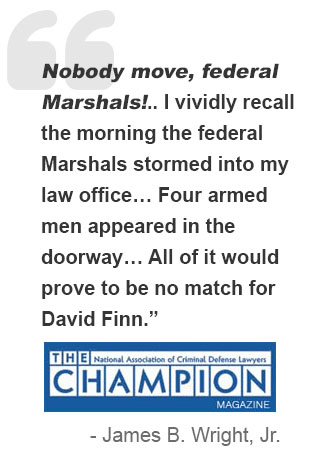
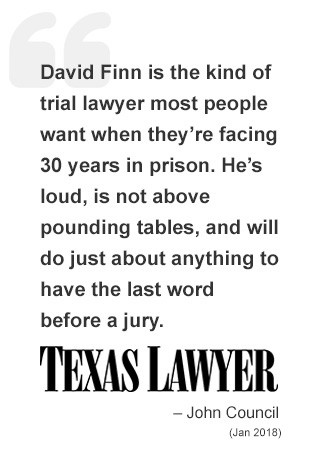
David Finn, P.C. is a Dallas federal and state defense attorney who has been on the Martindale-Hubbell list of Bar Preeminent Lawyers for over 13 years. This former federal prosecutor and elected criminal trial judge has consistently been named as a “Texas SuperLawyer” (2003-2018) as featured in Texas Monthly Magazine. SuperLawyers is a Thomson Reuters service. And Mr. Finn has also been consistently chosen as among the “Best Lawyers in Dallas” (2010-2018) by D Magazine in Dallas. If you are facing a criminal charge, David Finn is the criminal charge defense lawyer you want fighting for you.
General Federal Crimes FAQ
HOW LONG WILL IT TAKE TO RESOLVE MY CASE IF I AM CHARGED WITH AN OFFENSE IN FEDERAL COURT?
WHAT ARE SOME OF MY IMPORTANT RIGHTS IN FEDERAL COURT? PROBATION?
- You have a right to refuse to make any statements. If you have a lawyer, never make a statement to anybody without talking to your lawyer first.
- If you are charged with a felony, you have a right to have your case presented to a grand jury where a group of citizens vote as to whether there is probable cause to believe you committed the crime charged. If you are arrested for a felony offense before an indictment is returned, you have a right to a “preliminary hearing” where a magistrate judge determines if probable cause exists to believe you committed the crime charged.
- You have a right to be represented by an attorney and to have an attorney appointed by the court if you can show that you are unable to hire an attorney.
- You have a right to a detention hearing if the government seeks to keep you in jail pending your trial.
- You have a right to discover the evidence against you.
- You have a right to have the government prove any charge against you “beyond a reasonable doubt.” The “beyond a reasonable doubt” standard is the highest standard of proof that exists in the American justice system.
- You have a right to a speedy jury trial. Unlike in state court, a jury in federal court only decides the issue of guilt and innocence, not the sentence.
- If there is a trial, you have a right to testify at the trial. On the other hand, you cannot be forced to testify and, if you chose not to testify, that fact cannot be used against you.
- You have a right to use subpoenas to make witnesses come to court and testify on your behalf at any trial.
- You have a right, if there is a trial, to have your lawyer cross examine the government’s witnesses.
- You have a right to appeal your case and, if you cannot afford a lawyer, you have a right to an appointed lawyer on appeal.
I AM CHARGED WITH A DRUG OFFENSE IN FEDERAL COURT AND HAVE HEARD THAT THERE ARE SEVERE PENALTIES FOR DRUG CASES IN FEDERAL COURT, IS THAT TRUE?
I HAVE BEEN OFFERED A PLEA BARGAIN INSTEAD OF GOING TO TRIAL IN FEDERAL COURT. SHOULD I ACCEPT THE PLEA BARGAIN?
Some things to make sure you understand before accepting a plea bargain in federal court: (1) What will you be admitting to? (2) Does the plea bargain provide for a specific sentence? (3) Do you fully understand how the sentencing guidelines will affect your case and whether you will be eligible for a downward departure or subject to an upward departure? (4) Are there any mandatory minimum sentences that apply to your case? (5) If you are not a United States citizen, will the plea bargain affect your ability to remain in the United States? (6) If there will be a sentence of confinement, do you understand how “supervised release” works? (7) Are you waiving your right to appeal the application of the sentencing guidelines or will you be able to appeal how the trial judge applies the guidelines? Ask questions.
I HAVE TO MEET WITH A PROBATION OFFICER WHO WILL BE PREPARING MY PRE-SENTENCE REPORT, SHOULD MY LAWYER OFFER TO GO WITH ME TO THIS MEETING?
I EITHER LOST MY TRIAL OR PLEADED GUILTY IN FEDERAL COURT, BUT I AM NOT SATISFIED WITH THE OUTCOME. IS THERE ANYTHING I CAN DO?
WILL I SERVE MY WHOLE SENTENCE IN A FEDERAL CASE?


Phone Numbers
Office: (214) 538-6629
Office Location
Dallas